 You've done good, now get some rest Tommy!
Hat Tip: Deadspin:

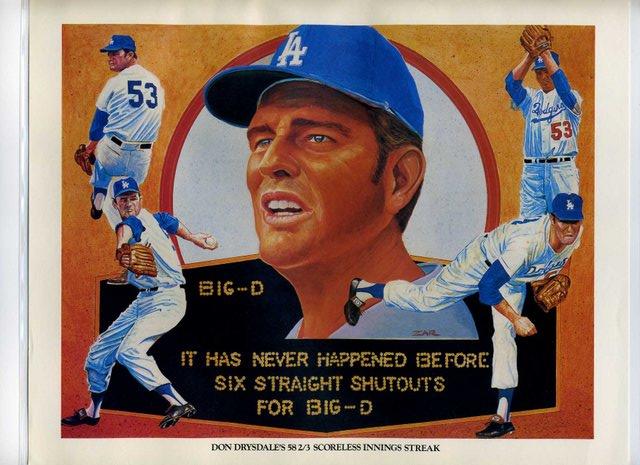 Following up on the game-used jersey of Don Drysdale I thought I would finally continue on with my posting on the 1984 Union Oil Most Memorable Moments set with this Drysdale classic. I had originally written about the Campanella sheet back in January, but never followed it up with additional post. As you'll recall, these 8" x 11.5" sheets were given away at Union Oil stations during the 1984 season.
"I hate all hitters. I start a game mad and I stay that way until it's over." (Quotes by players were no more comforting: "Don Drysdale would consider an intentional walk a waste of three pitches. If he wants to put you on base, he can hit you with one pitch." -- Mike Shannon. "I hated to bat against Drysdale. After he hit you he'd come around, look at the bruise on your arm and say, 'Do you want me to sign it?'" -- Mickey Mantle)You get the picture.

 Labels:
Andre Ethier,
Giants,
Grateful Dead,
Manny Ramirez,
Matt Kemp,
Rafael Furcal,
Russell Martin,
Videos
Labels:
Andre Ethier,
Giants,
Grateful Dead,
Manny Ramirez,
Matt Kemp,
Rafael Furcal,
Russell Martin,
Videos
 This is a very important piece of vintage game-used equipment. REA is auctioning off a catchers mask once owned and worn by Deacon White- the first man to wear a mask in professional Baseball. I'll let the auction description tell the story.
 This historically important catcher's mask was worn by Deacon White during the 1880s and originates directly from White's great-grandson, Roger Watkins, who has provided a one-page signed letter attesting to its provenance. Any and all nineteenth century game-used equipment is exceedingly rare, let alone examples that can be attributed to a specific player. What makes this particular piece even more significant is the fact that not only was White the first professional catcher to use a mask, but he also improved on its design. Ideally, the mask is accompanied by a circa 1920s newspaper clipping in which White recalls, first hand, how he was introduced to the new invention. In part:
One day during the season of 1875 at Boston, the papers announced that "The man with the iron mask would play a game of baseball for Harvard." Harry Wright asked me to go out with him and see the demonstration. A fellow named Fred Thayer, third baseman for Harvard, had made a big cage, much like a bird's cage, out of heavy iron wire. This the Harvard catcher, Jim Tyng, wore during the game. "What do you think of it?" Harry asked me. Well I told him such a mask hindered a catcher's work but I believe one could be made which would prove satisfactory. "Make one the way you think it should be made" he ordered. So I went to an iron worker in Boston and had him make me a mask out of steel wire. It fit over my face only, with padding around it, and was held on with elastic bands. This I used in catching Spalding for two seasons after that, and it came in handy when I went up behind the plate to catch my brother in 1878.
While we cannot state with certainty that the offered "spider-style" mask is the one referenced by White in the article, it may very well be and it is without question certainly one of the earliest examples in existence. Consisting of a network of strong metal wires, the mask features five separate pieces of leather padding, each affixed to the framework by its original metal fasteners. Three pieces of padding display additional reinforcement by means of vintage metal wire. No form of head strap is present. The mask displays heavy wear throughout, including numerous cracks and tears to each of the leather pads, but with no breaks to the framework. According to Watkins, this mask was found together with many other baseball items belonging to his grandfather: My great grandfather, James "Deacon" White, was a professional baseball player in the 19th century, playing for several teams in the 1860s-80s including the Cleveland Forest Citys, Boston Red Stockings, and Detroit Wolverines. Before she died, my grandmother, Grace White, brought a box full of Deacon's things to our house. We put the box in a closet where it remained unopened for many years. This spider style catcher's mask originates directly from Deacon White's personal collection.
 Most of the cards received were from issues totally foreign to me. For instance, the three cards on the top row in the photo above are 2006 Bazooka cards. I had no idea Topps made a Bazooka set. Not only that, I am totally fascinated by the Gagne card. Remember when McCourt took the players names off the back of the uniforms? That's a bit of recent Dodger past I'm glad is over. The best card of the group of 6 is on the bottom right. This is my first Greg Maddux card with him in a Dodger uniform. Awesome!
 The group of 9 cards above include some old friends. There are 2 Ramon Martinez's. That man could pitch. Nomo, Belcher and Grissom round out the other old Dodgers. The Matt Kemp card is absolutely wonderful. It is from a set I've seen before, but have not really searched for. It is designed after the vintage 1952 Topps set and looks great. I think it came out in 2006. I've got to get more Dodgers from that set.
 The nine above include Russell Martin, Jeff Kent and Chad Billingsley. The best card of the group, though, is Nomar Garciaparra. This is my first card with Nomar in a Dodger uniform.
 I love those Heritage cards of Saito and Furcal. The use of vintage designs with modern players was a good call by Topps. I might be forced to complete an entire set of these. At center is should-be Hall of Famer Maury Wills. Thanks you Ike's Cards.

