 What is great about this card is how distinctive it is. I'm not talking about the player (who had a 12 year career that ended in infamy), but a location that any Baseball novice can immediately tell you about. This 1993 Upper Deck card of Denny Neagle features a pic of him being engulfed by the outfield ivy at Wrigley Field before an afternoon game. He looks carefree as he is probably just hanging out before the game snagging batting practice balls. Well, he's hanging out since running after Baseballs seems to be the furthest thing on his mind. I would do anything to just have a moment to lay back on that ivy wall for just a second.

Monday, July 20, 2009
Card of the Week: Swallowed by Ivy
What is great about this card is how distinctive it is. I'm not talking about the player (who had a 12 year career that ended in infamy), but a location that any Baseball novice can immediately tell you about. This 1993 Upper Deck card of Denny Neagle features a pic of him being engulfed by the outfield ivy at Wrigley Field before an afternoon game. He looks carefree as he is probably just hanging out before the game snagging batting practice balls. Well, he's hanging out since running after Baseballs seems to be the furthest thing on his mind. I would do anything to just have a moment to lay back on that ivy wall for just a second.


2009 Obak Previews
Modern cards borrowing their design from vintage sets is all the rage today. Topps has the Allen & Ginter set, Upper Deck will be releasing their inaugural Goodwin Champions set and now TriStar (maker of minor league cards) has Obak.
As indicated above, TriStar has become the preeminent producer of Minor League Baseball cards for the hobby, so it only makes sense that their throwback set take its design from a vintage minor league set. Obak tobacco cards were produced from 1909 to 1911 and featured only West Coast minor league teams and players. They are very rare and complete sets are scarce in the hobby. VG examples of common cards will set you back about $65 to $85 a piece. The vintage set has been designated as T212 and are of the same size as other tobacco issues from the period. Go to this link for some more info about it.
Anyway, the only card released so far that interest us Dodger fans is the below Duke Snider autographed card with him in his Texas League Fort Worth Cats uniform. When this photo was originally taken he could only dream of the Hall of Fame career he would eventually have.

Hat Tip: Sports Card Info:
Friday, July 17, 2009
Squid Attack!
Check out this great video first, then read all about it here.
YouTube Link:rogeruzun:
Hat Tip: AmericaBlog:
YouTube Link:rogeruzun:
Hat Tip: AmericaBlog:
Dodger Correspondence: Fred Fitzsimmons
I have returned with a new edition of Dodger Correspondence- letters written by old-time Dodger players to their fans.
I am sure many of you have, especially while you were younger, written a letter to your favorite player asking for an autograph and maybe some words of encouragement. For instance, last week I shared a letter from NorCal resident Dickey Ow who asked Ernie Koy what he should do to be a professional ballplayer. Other times you might ask about the highlight of a players career like when Earl Mosser shared with Jim how he struck out Stan "The Man" Musial in his first inning of work in the big leagues.
Today I share a letter written by Fred Fitzsimmons, otherwise known as "Fat Freddie", to a fan named Dean who wants to know who was the greatest player he ever played with or against. That's a very difficult question to ask from a man who played and coached professionally from 1920 to 1966.

 (click to enlarge)
I am sure many of you have, especially while you were younger, written a letter to your favorite player asking for an autograph and maybe some words of encouragement. For instance, last week I shared a letter from NorCal resident Dickey Ow who asked Ernie Koy what he should do to be a professional ballplayer. Other times you might ask about the highlight of a players career like when Earl Mosser shared with Jim how he struck out Stan "The Man" Musial in his first inning of work in the big leagues.
Today I share a letter written by Fred Fitzsimmons, otherwise known as "Fat Freddie", to a fan named Dean who wants to know who was the greatest player he ever played with or against. That's a very difficult question to ask from a man who played and coached professionally from 1920 to 1966.

You asked me who I thought was the greatest player I ever played with or against. I could not pick any one. There were a number of Great players. Hornsby- Frisch, Terry- Ott, Traynor, Waner Brothers - Lloyd & Paul, Hartnett, Roush, Hubbell. Dean, these are players in the Nat. League. Ruth, Cronin in the American League. I was a very lucky fellow to be able to play as long as I did.
I started in 1920 and finished in 1966. 19 years in the National League pitching- Won 217, pitched in 3 World Series, coached in 3 World Series.
 (click to enlarge)
Thursday, July 16, 2009
Going GaGa Over 2009 Allen & Ginter Dodgers
The internet is a flutter as a result of the recent release of Topps 2009 Allen & Ginter Baseball cards. Well, at least the card blog community is. Everywhere you go there are post singing its praises. As you can see below, you'll soon find out why.
The design is flawless. A lightly drawn black border surrounds the footer and portrait. The drawings are colored in soft pastels with an almost bleach-white background which allows the colors to swirl. The players last name sits in a box while resting above the trademark. The Allen & Ginter name is done in a style reminiscent of its grandfather card set. The original vintage A&G set was created in 1887 and were inserts within packs of cigarettes- such were the origins of all card collectibles.
 Brooklyn, New York on the very bottom is a nice touch. Nevermind that it has nothing to do directly with the Dodgers. It represents the original birthplace of the Topps Company.
Below I have pulled out photos from eBay and GCRL (I hope you don't mind) of every Dodger card in the set I could track down. There are numerous variations available and I figure it would only be right to show them all (at least what I could find) since most may never reach our hands. As soon as I start I hope to gather up just the base cards for my set.
The Billingsley above is a base card- meaning it's a regular part of the set. So far I count 12 Dodger base cards. As I said above, there are plenty of rarities as well. Below is a "rip" card of Chad Billingsley. A "rip" card is very rare as they come only one per case. They are essentially a card within a card. On the reverse is a small pull tab that when opened hides a short printed mini card the size of original tobacco cards. You'll see an example a little further down. Chad's card is one of only fifty available. They also come in print runs of 99, 25, 10 and 5.
 Here is a very well done base card of Clayton Kershaw. I love how he sports a menacing stare as he shows us his fastball. He is almost daring you to hit him.
 Another rare variation is the Kershaw short printed mini card below that was found in a "rip" card. I don't know if I could ever open up one of those cards. It's like playing the lottery. You could get something worse than what you already have. Of course, card collecting is like gambling so who am I fooling? I'd rip one open.
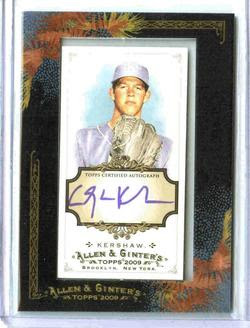
 There are also randomly inserted autographed card of your favorite players like Kershaw below. It is signed on a mini card that has been encased in a plastic frame. You are sure not to damage these cards.
 Russell J. Martin seems to always have great looking cards. Below is his base cart to the set.
 Rafael Furcal's base card is below.
 Now here is one of the coolest limited inserts available in the set. Below is a Furcal silk card. Every card in the base set has a parallel version like this one number to just 10. I couldn't imagine anyone trying to put together a complete silk set. That would be maddening and expensive.
 Are you seeing a trend here? Most of the cards have the players sporting very serious looks. Their eyes are piercing or their expression muted. Casey Blake's base card makes him look a little angry.
 Even on Manny's base card he can barely give a smile.
 Below are three different insert mini cards of Manny Ramirez. Within each pack of cards comes some base cards and one mini card. The mini cards mimic the base cards They also have there own limited variations. To the left is a black border mini, at center a rare mini A&G back variation, and to the right is the mini base card. Are you confused yet? Too many variations and parallels to boggle the mind.
 Each base card has a normal size card, a mini, a mini silk, a black bordered mini version and a A&G back variation card. On top of that, there are short printed mini cards found in "rip" cards that are in addition to the 350 card base set (making a truly complete set at 400 cards) like the Kershaw above and the Manny Ramirez below. Whew!
 Oh, no! There's more. Within each box of 18 packs is a box loader. A box loader is a special pack that holds a larger size card. These cards are fashioned after the vintage A&G N43 set from 1888. Below is Manny's card.
 There are even cut game-used uniform pieces within the N43 subset like the Manny below.
 There are also several subsets like the National Pride card below of Manny Ramirez.
 So you can't get enough of Manny, right? Well, how about the below two inserts of bat and jersey pieces.

 Andre Ethier continues with the theme of sternly posed game faced portraits in this base card below.
 Oh, wait! I have led you astray. You can also pull a rare 1 of 1 wood card mini version of the base set. We are up to 6 different versions of each card.
 Ethier's "rip" card is numbered to 25.
 James Loney looks straight at you when he wants to challenge you.
 Loney's "rip" card shows off his follow through. His eyes show total concentration.
 Blake DeWitt almost smiles. Alas, it's just a knowing grin.
 DeWitt's wooden card is below.
iq!~~_12.JPG) DeWitt also has a autographed insert and bat cards in the set.

 The Bison, Matt Kemp, snarles at us in his base card.
 Kemp's "rip" card has him gazing in the direction of where he will be hitting the ball- way out there.
 Matt Kemp was also kind enough to sign a few as you can see below.
 Hiroki Kuroda, in his base card below, looks as stone faced as Moneymaker at the poker table.
 Kuroda also has his own National Pride card.
 Last, but not least is James McDonald's rookie base card. He is posed below in a poormans multiple exposure pose of him delivering his pitch.
 This is all for now. There are still a couple of more cards I have yet to stumble upon. So, as you can imagine, completing a truly complete Dodger set would be very difficult.
Photo Help from eBay and GCRL:
The design is flawless. A lightly drawn black border surrounds the footer and portrait. The drawings are colored in soft pastels with an almost bleach-white background which allows the colors to swirl. The players last name sits in a box while resting above the trademark. The Allen & Ginter name is done in a style reminiscent of its grandfather card set. The original vintage A&G set was created in 1887 and were inserts within packs of cigarettes- such were the origins of all card collectibles.
 Brooklyn, New York on the very bottom is a nice touch. Nevermind that it has nothing to do directly with the Dodgers. It represents the original birthplace of the Topps Company.
Below I have pulled out photos from eBay and GCRL (I hope you don't mind) of every Dodger card in the set I could track down. There are numerous variations available and I figure it would only be right to show them all (at least what I could find) since most may never reach our hands. As soon as I start I hope to gather up just the base cards for my set.
The Billingsley above is a base card- meaning it's a regular part of the set. So far I count 12 Dodger base cards. As I said above, there are plenty of rarities as well. Below is a "rip" card of Chad Billingsley. A "rip" card is very rare as they come only one per case. They are essentially a card within a card. On the reverse is a small pull tab that when opened hides a short printed mini card the size of original tobacco cards. You'll see an example a little further down. Chad's card is one of only fifty available. They also come in print runs of 99, 25, 10 and 5.
 Here is a very well done base card of Clayton Kershaw. I love how he sports a menacing stare as he shows us his fastball. He is almost daring you to hit him.
 Another rare variation is the Kershaw short printed mini card below that was found in a "rip" card. I don't know if I could ever open up one of those cards. It's like playing the lottery. You could get something worse than what you already have. Of course, card collecting is like gambling so who am I fooling? I'd rip one open.
 There are also randomly inserted autographed card of your favorite players like Kershaw below. It is signed on a mini card that has been encased in a plastic frame. You are sure not to damage these cards.
 Russell J. Martin seems to always have great looking cards. Below is his base cart to the set.
 Rafael Furcal's base card is below.
 Now here is one of the coolest limited inserts available in the set. Below is a Furcal silk card. Every card in the base set has a parallel version like this one number to just 10. I couldn't imagine anyone trying to put together a complete silk set. That would be maddening and expensive.
 Are you seeing a trend here? Most of the cards have the players sporting very serious looks. Their eyes are piercing or their expression muted. Casey Blake's base card makes him look a little angry.
 Even on Manny's base card he can barely give a smile.
 Below are three different insert mini cards of Manny Ramirez. Within each pack of cards comes some base cards and one mini card. The mini cards mimic the base cards They also have there own limited variations. To the left is a black border mini, at center a rare mini A&G back variation, and to the right is the mini base card. Are you confused yet? Too many variations and parallels to boggle the mind.
 Each base card has a normal size card, a mini, a mini silk, a black bordered mini version and a A&G back variation card. On top of that, there are short printed mini cards found in "rip" cards that are in addition to the 350 card base set (making a truly complete set at 400 cards) like the Kershaw above and the Manny Ramirez below. Whew!
 Oh, no! There's more. Within each box of 18 packs is a box loader. A box loader is a special pack that holds a larger size card. These cards are fashioned after the vintage A&G N43 set from 1888. Below is Manny's card.
 There are even cut game-used uniform pieces within the N43 subset like the Manny below.
 There are also several subsets like the National Pride card below of Manny Ramirez.
 So you can't get enough of Manny, right? Well, how about the below two inserts of bat and jersey pieces.

 Andre Ethier continues with the theme of sternly posed game faced portraits in this base card below.
 Oh, wait! I have led you astray. You can also pull a rare 1 of 1 wood card mini version of the base set. We are up to 6 different versions of each card.
 Ethier's "rip" card is numbered to 25.
 James Loney looks straight at you when he wants to challenge you.
 Loney's "rip" card shows off his follow through. His eyes show total concentration.
 Blake DeWitt almost smiles. Alas, it's just a knowing grin.
 DeWitt's wooden card is below.
iq!~~_12.JPG) DeWitt also has a autographed insert and bat cards in the set.

 The Bison, Matt Kemp, snarles at us in his base card.
 Kemp's "rip" card has him gazing in the direction of where he will be hitting the ball- way out there.
 Matt Kemp was also kind enough to sign a few as you can see below.
 Hiroki Kuroda, in his base card below, looks as stone faced as Moneymaker at the poker table.
 Kuroda also has his own National Pride card.
 Last, but not least is James McDonald's rookie base card. He is posed below in a poormans multiple exposure pose of him delivering his pitch.
 This is all for now. There are still a couple of more cards I have yet to stumble upon. So, as you can imagine, completing a truly complete Dodger set would be very difficult.
Photo Help from eBay and GCRL:
Subscribe to:
Posts (Atom)
