Every once in while (OK, more than once in a while),
REA likes to communicate about issues that we think
deserve attention but for some reason are receiving
little or no attention. There are several topics
that we would like to bring to the attention of
buyers today, in the hopes of educating buyers
and maybe saving someone money.

1) Practically every day we are seeing fake items.
Fake printed items. Posters that are actually
reproductions of vintage posters. Stand-up
cardboard counter displays that are not real.
Babe Ruth Candy wrappers that are not
real. Fans that picture baseball player portraits
that are reproductions. Photographs that appear
to be old but are not vintage. There is no limit
to what can be made with computers, especially
with printing equipment available today that is
very economical and which years ago did not
even exist. These items are being intentionally
made to fool people into parting with their
money for worthless items. These items are
being made to cheat buyers. Many of these items
are somehow reproduced from books and
auction catalogs, often enlarged from small
quality illustrations to their correct original
size. With computers these days, it is possible
for some criminals to produce very real- looking
reproductions and also to produce “fantasy
pieces” (defined as those items that are not
actually reproductions, as there is no
original, but are made to look old to fool
buyers). This is a BIG problem. These items are
offered to us practically every day, and they
are being offered to us by collectors who
themselves are victims. Most of the
sophisticated fake items of this type that we
have seen appear to have one thing in common:
They were purchased by sellers in the state of
Ohio. It is obvious to us that the individual(s)
resp onsible for most or all of these
imaginative quality fakes is located in
the state of Ohio, though these items are now
circulating throughout the country. It is easy
for us to tell in almost all cases whether an
item is real or not, often just from a scan.
We understand from experience that not
everyone can, including the numerous victims who
have sent us these recently produced fake items
which at a glance appear to be vintage items.
If you think that you have purchased a fake
item of this type and would like our opinion,
we will be happy to be of assistance. Please
write and/or send scans.


2) In recent weeks we have received a number of
consignments of graded cards that has motivated us
to adopt a formal policy regarding altered
professionally graded cards that we have not
previously seen a need to articulate. The
altering of cards is so widespread, and “card
doctors” so brazen, that REA has actually been
receiving cards submitted for auction to us that
are the very same cards that have been sold by
REA previously – in some cases
just months earlier – and which, since purchase,
have been significantly altered, reholdered, and now
grade higher according to the grading label. In some
cases a given card has changed hands and the new
consignor was not even aware it was a seriously
altered card. It is our policy that when we are
aware of such a problem, and we ARE looking, we
will be happy to auction the card in question -
but insist on providing all information
describing the alterations which have occurred
to the card of which we are certain. So far,
the potential consignors of such cards have
elected to have these cards returned rather
than have a proper description provided by
REA. Last week we returned a $10,000
card. The consignor couldn’t believe it was the
same card that we had just sold (in a lower grade
and looking quite different) in a previous auction.
Only after being provided with images of the card
as it appeared when we previously sold it was
the consignor finally convinced.

We’re not guessing here. We are talking about
cards that we know for a fact are problems.
The fact that we have to address situations
such as this at all suggests
a greater underlying problem than is generally
recognized. And while it is bad enough that the
altering of cards is an epidemic, it is
particularly disturbing that some of the most
sophisticated “work” on cards (including the
previously mentioned $10,000 card) has actually
been executed by employees of auction
houses that also deal in cards. We have to ask
ourselves “What is going on here?” Turning a
blind eye to this issue, in our opinion, has
far greater and more significant negative
potential consequences than our calling
attention to it and promoting discussion. We
all know that there is a subjectivity to grading
and that sometimes there is an honest difference
of opinion regarding a grade, or sometimes even
an honest mistake. We’re not talking about
honest mistakes here. Active and sophisticated
collectors, dealers, and auction houses know
that this is a problem. They just don’t talk
about it, except among themselves. In the end,
the collector loses. We want to be clear that we
think the major grading services do a valiant
job and we can’t imagine what the landscape of
the marketplace would look like without them.
That doesn’t mean there are no problems. At
the end of the day, we have this advice: “Buy
the card, not the holder.”

Thursday, October 26, 2006
A PSA from REA: "Buy the Card, Not the Holder"
Every once in awhile Robert Edwards Auctions sends out helpful information to the vintage card collector. This afternoon I received an important note that all vintage card collectors need to be weary of. Since it came in a email I will reprint the most important points here in entirety.


Friday, October 20, 2006
Fall Classic: Tigers vs. Cardinals
Congratulations to the Tigers, Cardinals and their fans. I think this should be a great series.
The last time they met in 1968 the Tigers took home the crown in 7 games. Mickey Lolich, who won 3 games, and Denny McLain led the Tigers to victory. Al Kaline finally won his ring.
The last time they met in 1968 the Tigers took home the crown in 7 games. Mickey Lolich, who won 3 games, and Denny McLain led the Tigers to victory. Al Kaline finally won his ring.
New Babe Ruth Rookie Discovered
 Via Sports Collectors Daily we find out about a new Babe Ruth discovery. The above picture is of a 4.5 x 6.5 inch team card of the 1914 Baltimore Orioles of the International League- Ruth's minor league team and first year in profession Baseball. It was produced by Baltimore News and is probably one of a kind. (or, at least, other examples have not survived the test of time)
In the newly discovered team photo card, Ruth appears standing in the upper left of the back row. Also included among the players shown are Ernie Shore and Ben Egan, who along with Ruth, on July 10, 1914 were sold to the Boston Red Sox by Baltimore Orioles' owner Jack Dunn for a reported $25,000. When the Federal League established a major league team in Baltimore in 1914, directly across the street from the minor league Orioles, the competition hurt Orioles' attendance significantly. Some games drew as few as fifty fans in the stands. To avoid bankruptcy, Dunn was forced to sell his best players to Red Sox owner Joseph Lannin.
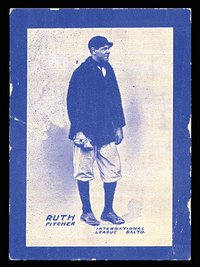 Also included in the find is the above 1914 Baltimore News Baseball card of Babe Ruth. This is one of only 10 cards known to exist and is very rare. In fact, if a mint example where ever found it might sell for more than the T206 Honus Wagner.
Hat Tip: James Feagin: Vintage Baseball Card Forum:
Tuesday, October 17, 2006
My Only Regret is that I Don't Play Golf
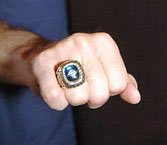 So, this past Thursday a bunch of guys from my office took the afternoon off to play some golf. It was for a charitable event that the Director of the company I work for help start and put together. The charity is called New Directions for Women. It is a non-profit drug and alcohol treatment provider for women, pregnant women and women with children. It's a great cause that seeks to address an important need.
Anyway, I don't golf at all. In fact, my swing is so bad I should just take a Baseball bat with me to hit those little balls instead of a driver. So, I opted to not participate on that afternoon. I would soon regret that decision.
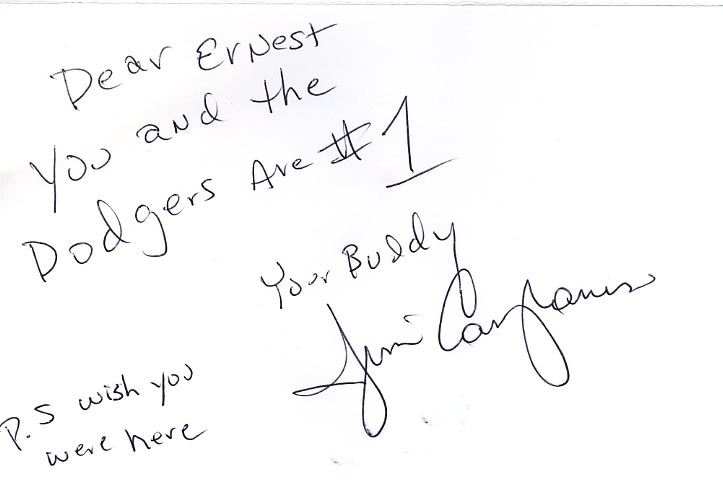
Mr. Jim Campanis, former Dodger farmhand and son of Al Campanis, the former Dodger GM was on hand that afternoon.
Just my luck, right?
He retold stories of his time in Baseball and the Dodgers. More importantly, he was wearing his 1988 Los Angeles Dodgers World Series ring. In fact, he let a bunch of folks wear his ring. Below is Jim, my boss, wearing the ring with Mr. Campanis by his side (on the right). The interns from my office also had a chance to put on the gold and diamond clad beauty.
At the same time I was in the office working. What kind of idiot am I!

Friday, October 13, 2006
Dodgers: 1940's-1950's Baseball Player Pendants
As I promised earlier, below are the 3 Dodger players I received in the lot of 1940's-1950's Baseball Player Pendants I received. These are very small, measuring approx. 1/2 inch by 3/4 inch. 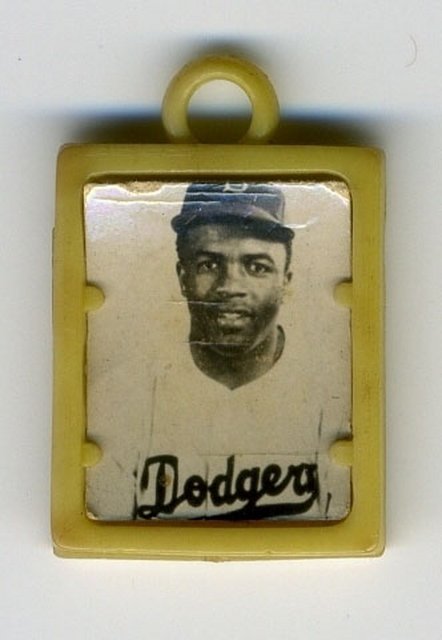 Below is Hall of Famer Pee Wee Reese.
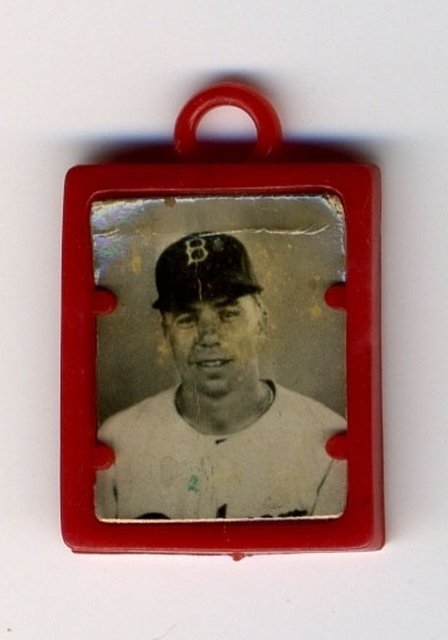 Below is Carl Furillo.
Below is Hall of Famer Pee Wee Reese.Below is Carl Furillo.
Thursday, October 12, 2006
Please Help Me Identify These Players
I recently won an auction of a small collection of 1940-1950's Baseball Player Pendants at Hunt Auctions. There were 11 different pendants in the lot. I also got an extra Jackie Robinson pendant. I'll post the Dodger pendants I received at a later point. Right now, my focus is to determine who the other players are. Please help out if you can.
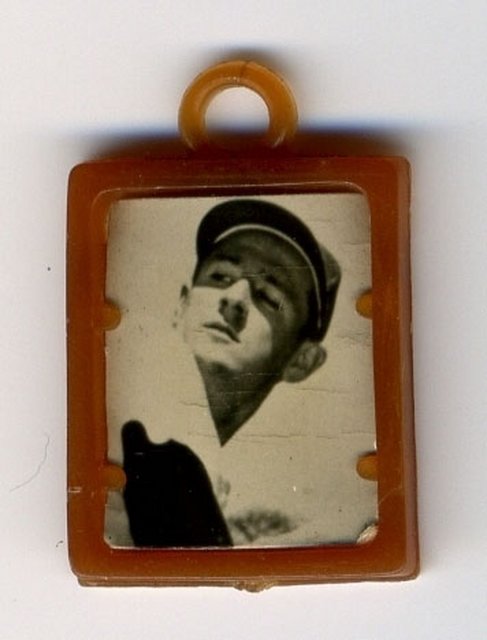 1: I think the above pic is Whitey Ford, but I'm not sure.
 2: I think this is Whitey Lockman. Anyone know for sure?
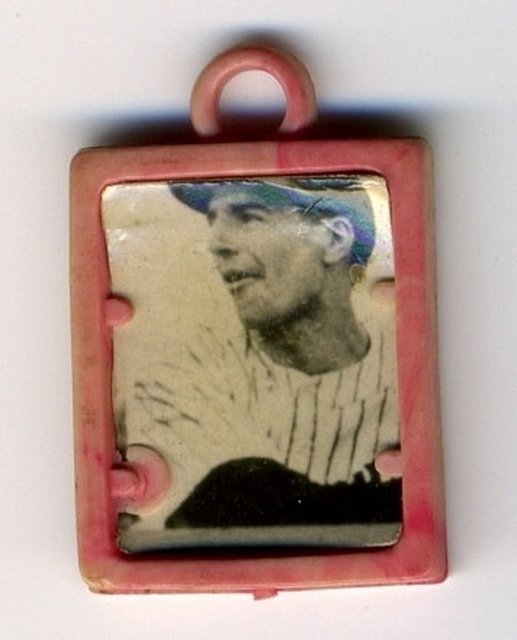 3: I'm almost sure this is Phil Rizzuto.
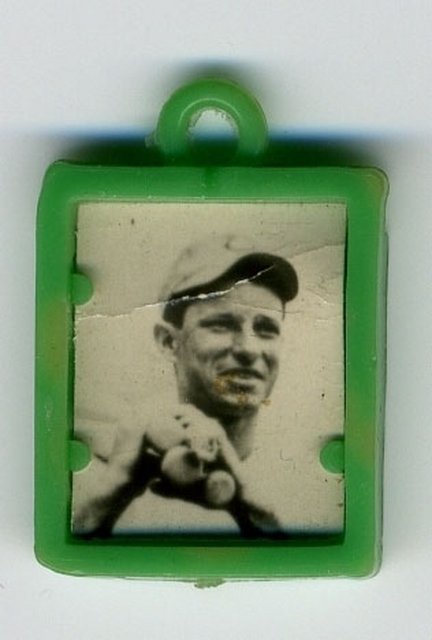 4: I have no clue who this is!
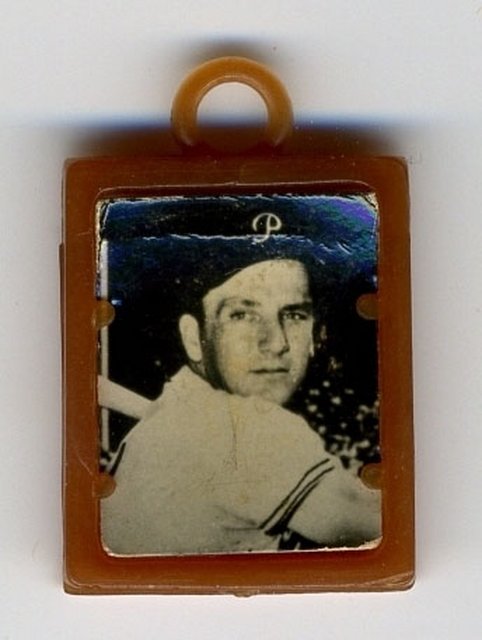 5: Is this Richie Ashburn?
1: I think the above pic is Whitey Ford, but I'm not sure.2: I think this is Whitey Lockman. Anyone know for sure?3: I'm almost sure this is Phil Rizzuto.4: I have no clue who this is!5: Is this Richie Ashburn?
Any help you can provide would be greatly appreciated.
Update: Well, I posed the same question over at the Vintage Baseball Card Forum and received some good feedback. #5 is Ralph Kiner, #4 is Andy Pafko, #3 is Phil Rizzuto. #1 & #2 are still up in the air.
Update: Well, I posed the same question over at the Vintage Baseball Card Forum and received some good feedback. #5 is Ralph Kiner, #4 is Andy Pafko, #3 is Phil Rizzuto. #1 & #2 are still up in the air.
Subscribe to:
Posts (Atom)
